
Your child’s mental health begins with your social-emotional skills. We help you build these skills using our science-backed approach.
Founded by a neuroscientist & mom of 3.
Your child’s mental health begins with your social-emotional skills. We help you build these skills using our science-backed approach.
Founded by a neuroscientist & mom of 3.

Better stress management
You are not reactive because you notice your dysregulation

Healthy emotional coping
You don’t get stuck in your frustration or amplify your anger.

You resolve conflict better
Interactions with your partner or kids are not as emotionally depleting.
Social-emotional skills help parents notice what they are feeling, manage stress when emotions rise, and navigate difficult interactions with greater intention. These skills shape how we respond to frustration, handle conflict, and repair relationships after hard moments.
Most parents were never taught these skills growing up. Yet once we become parents, we are expected to model them every day. The way we cope with stress, interpret our child’s behaviour, and communicate during conflict becomes the emotional blueprint our children learn from.
At Curious Neuron, we help parents strengthen five core social-emotional skills: emotional awareness, stress and nervous system regulation, perspective taking, healthy conflict and repair, and emotional leadership. As these skills grow, everyday interactions at home begin to feel calmer, clearer, and easier to navigate.
Learn from our free educational content and start building an emotionally healthy home
We keep you current on the science of emotional health (for you and your child)
Read ArticlesReal-life parenting struggles & insights from research. Hosted by a neuroscientist.
Listen to the PodcastEnhance your emotional intelligence as a parent, and supporting your child’s emotional growth.
View Resources
Strong social-emotional skills at home start with your emotional awareness. Most parents only notice their reactions once they’ve already escalated (red zone), but stress often follows a predictable climb. When you learn to recognize your internal states early (notice the red zone), you can interrupt your reactivity and dysregulation before you reach your overloaded state.
Inside our Reflective Parenting Program, you build the skills to notice your triggers, regulate your nervous system, repair after conflict, and model emotional safety for your child. Using our Regulation Mountain framework, you move from reactive to reflective — creating a home where calm replaces chaos and connection replaces power struggles.
I worked with Dr. Hovington for years, having her evaluate & counsel our patients, but now as a referral source for all [parents]. Being that I have a very large pediatrics practice, it has been extremely important to avail myself of all that could enhance & simplify the lives of my young families & their children…Dr. Hovington’s conscientious, professional endeavour, Curious Neuron, does just that!
 -Dr. Derek da Costa,
Physician MD, Chief Medical Advisor
As parents, we aren’t taught how to cope with social-emotional skills.
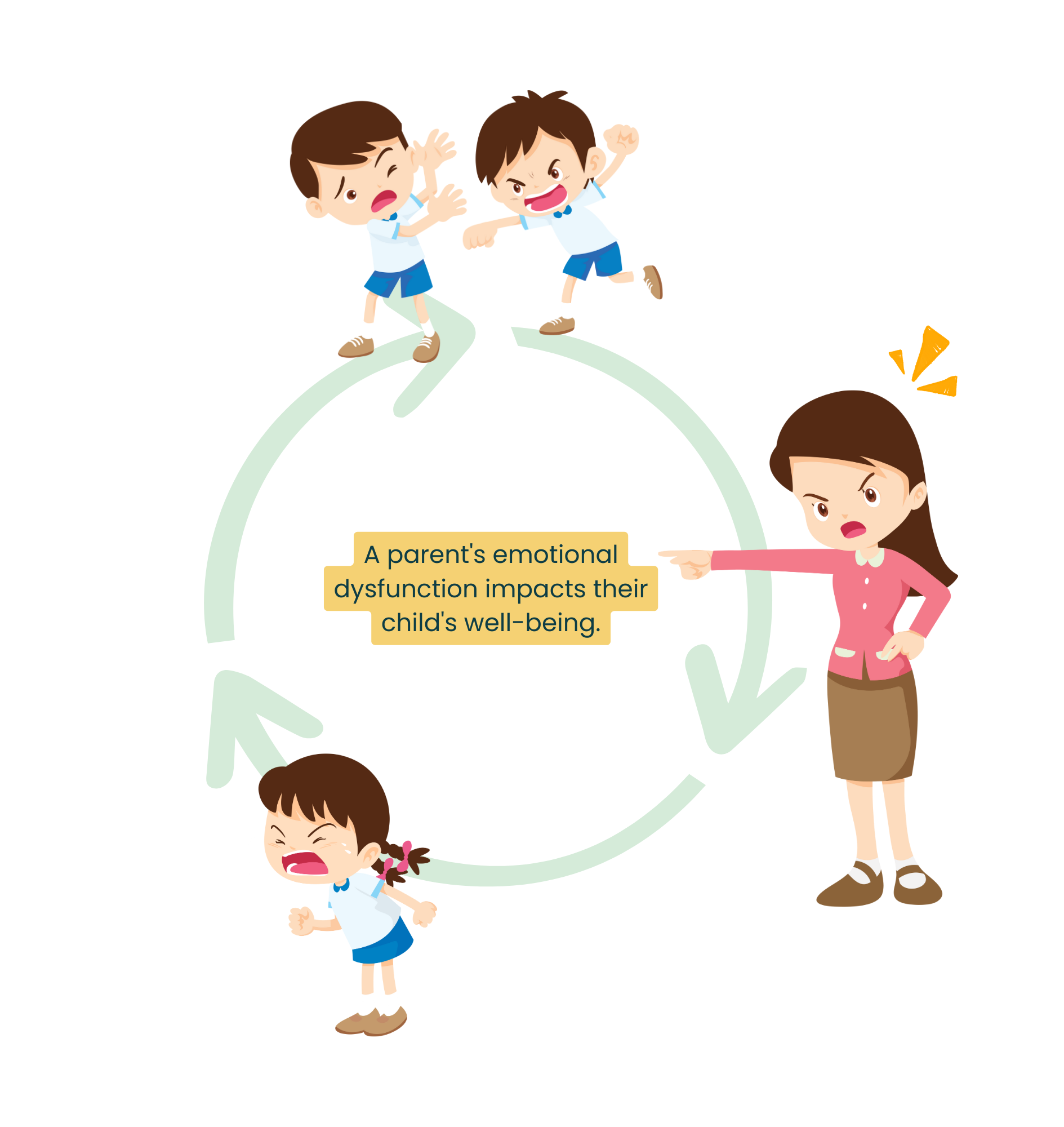
As a result, we struggle with managing our emotions and easily triggered when our kids act out. We snap when they act out (rather than offering emotional support) or we lose patience with them quickly and end up escalating a situation.
Your child needs to see healthy and effective social-emotional coping skills to learn how to do it themselves. Without seeing these in action (problem solving cognitive reappraisal etc), children may experience more behavioural challenges as they learn to navigate their own emotions.
By developing these important emotion regulation skills ourselves, we can actually foster a more balanced and connected family environment.
“Our kids mirror the energy we bring to the room. When I understand my own triggers first, I can finally be the “calm to their chaos.” When they feel my groundedness, they find their own and realize we’re in it together. Reflective Parenting has been life-changing in our home.”
Reflective Parent (Mom of 2, California)
Curious Neuron partner’s
with pediatric clinicians:
Your patients can have access to:
Access to free webinars (only available for our partners)
Aliquam non lectus id purus cursus porta. Nullam vel felis elementum, ornare magna non, feugiat ex. Phasellus erat ligula, laoreet sit amet magna vel, aliquet facilisis libero.
Children with stronger emotion regulation skills show lower levels of later anxiety and depression symptoms (Compas et al. 2017)
Emotion regulation is directly linked to lower mental health symptoms:
In a large meta-analysis of more than 80,000 children, stronger emotion regulation skills were consistently linked to lower levels of anxiety, depression, and behavioral difficulties
Unhealthy coping increases risk of mental illness:
When children rely on avoidance or maladaptive coping strategies like suppression or rumination, rates of anxiety and depression are significantly higher.
Parents’ ability to cope with their emotions helps shape children’s emotion regulation, attachment security, and stress responses, all of which are key protective factors for long-term mental health (Duncan et al., 2009; Islamiah et al., 2023; Iwanski et al., 2025).

Helping people build the emotional skills needed to thrive in their relationships, workplaces, and everyday lives.
Copyright © 2026 Curious Neuron | PRIVACY POLICY | TERMS & CONDITIONS | Branding & Design by Kelly De Luca Design & Co.