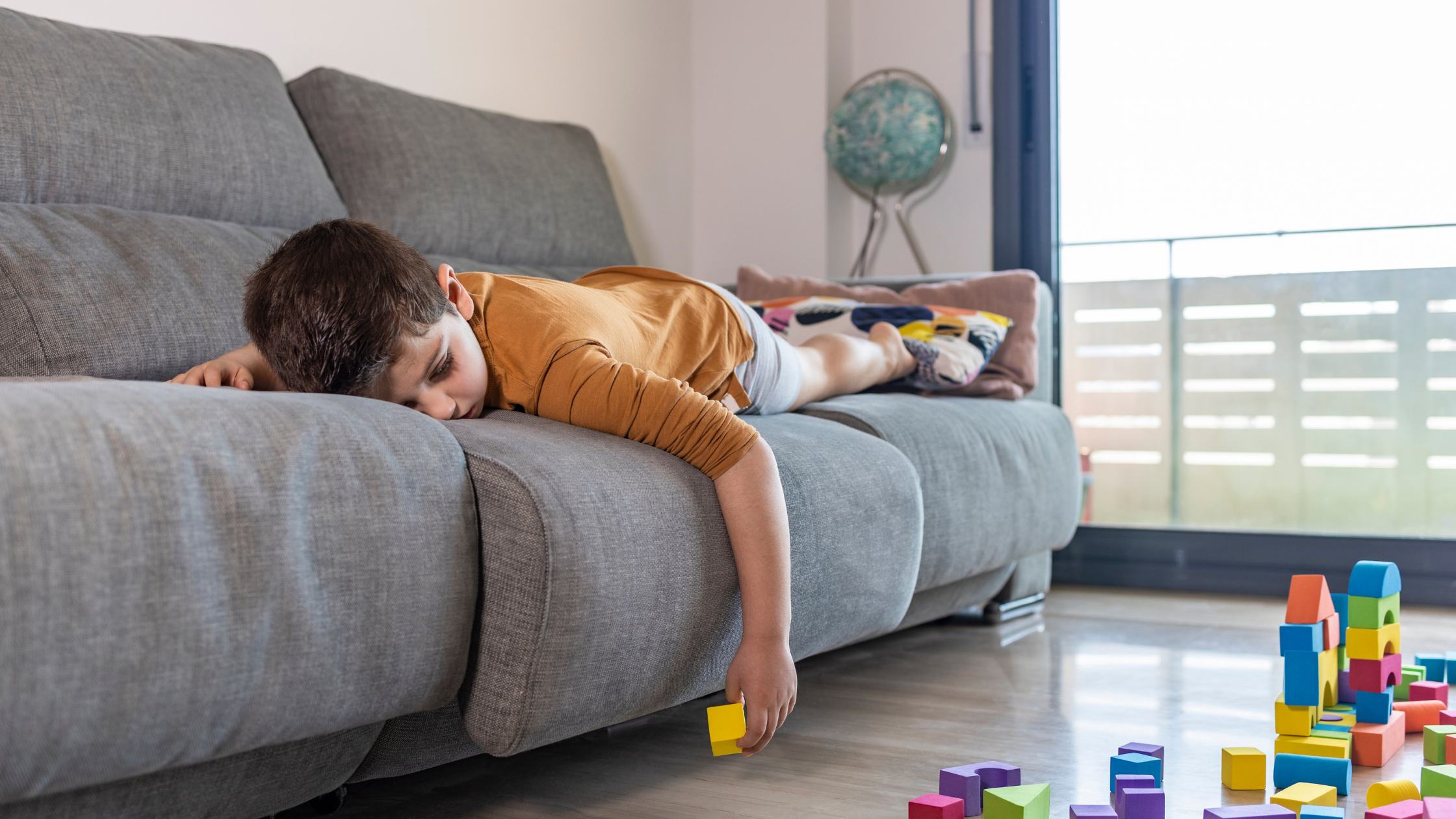

“I’m bored.” It’s a phrase many parents hear almost every day. When children say it, our instinct is often to fix it… quickly because as a parent, our child’s boredom can also be triggering to us. We suggest activities, hand them a toy, turn on a TV show, or try to “keep them entertained”.
However, research suggests that boredom may actually play an important role in your child’s development. Instead of being something parents need to eliminate, boredom may be one of the experiences that helps children learn how to explore, create, and regulate themselves.
Understanding why boredom is good for kids can help parents feel more confident about allowing unstructured time in their child’s day.
What Is Boredom?
Boredom is a psychological state that occurs when someone has difficulty engaging their attention with what is happening around them. It can happen when an activity feels repetitive, uninteresting, or when the environment does not provide enough stimulation.
Researchers studying boredom in children have found that even young children experience boredom and respond to it in meaningful ways. A recent study examining boredom in children aged 4–6 found that boredom is closely linked to self-regulation skills, including attention and behavioural control (Anderson and Perone, Journal of Experimental Child Psychology, 2024).
In other words, boredom is not just a complaint. It is an emotional signal that pushes children to seek stimulation and engagement.
What Research Shows About Boredom in Children
This study by Anderson and Perone exploring boredom in early childhood observed how children respond when they feel bored. Researchers found that most children actively tried to solve the problem by initiating new activities or seeking interaction with others.
Children commonly responded to boredom by:
-
starting a new activity
-
exploring toys or their environment
-
asking someone to play with them
These responses suggest that boredom can motivate children to create stimulation rather than passively wait to be entertained.
However, researchers also found that children differ in how easily they cope with boredom. Some children struggle more with boredom and rely heavily on external stimulation. Studies on boredom proneness suggest that children who have difficulty managing boredom may have fewer strategies for engaging themselves or regulating their attention (Lehr and Todman, 2009).
This highlights something important for development: learning how to tolerate boredom is a skill that children develop over time.
Understanding why boredom is good for kids helps parents see that these moments are opportunities for children to practice independence and self-directed behaviour.
How Boredom Supports Development
Although boredom may feel uncomfortable, research suggests it can support several important developmental processes.
Creativity
Studies suggest that boredom can stimulate creative thinking. When people experience boredom, their minds often begin searching for new ideas and stimulation. This mental shift can encourage imagination and creative problem-solving.
Problem-Solving
When children do not have structured activities provided for them, they must generate their own ideas for what to do next. This process strengthens problem-solving skills and independent thinking.
Self-Regulation
Learning to tolerate boredom requires children to manage uncomfortable emotions and redirect their attention. This helps develop emotional regulation skills that are important for school and social interactions.
Initiative
Boredom encourages children to initiate play on their own rather than relying on adults to structure their time.
In this way, boredom creates the space where children begin to explore, imagine, and invent. When parents understand why boredom is good for kids, it becomes easier to see these moments as valuable rather than problematic.
Why Boredom Matters More Today
In many modern households, children’s lives are filled with structured activities and constant stimulation. Between organized sports, extracurricular programs, and digital entertainment, children often have fewer opportunities for unstructured time.
While these activities can be beneficial, they can also reduce the amount of time children spend initiating their own play.
Research on play and child development consistently shows that unstructured play supports cognitive, emotional, and social development (The Impact of Play on Child Development: A Literature Review). When boredom leads children to initiate play, they are practicing skills that support learning, creativity, and emotional growth.
Understanding why boredom is good for kids can help parents feel more comfortable stepping back and allowing children the space to create their own experiences.
What Parents Can Do
Parents do not need to eliminate boredom from their child’s life. In fact, allowing moments of boredom can support healthy development.
Here are a few ways to approach boredom differently:
Allow unstructured time.
Not every moment of a child’s day needs to be planned. Give them time at home without screen time where they get to decide what to do or play. With kids 6 and younger, offer them open-ended toys such as pretend food, animal figurines, building blocks, kitchen items that are safe for them (bowl, spoon, whisk).
Pause before solving boredom.
Give children time to think of something to do before offering suggestions.
Encourage open-ended play.
Activities like drawing, building, or pretend play allow children to create their own ideas.
Normalize boredom.
Let children know that feeling bored sometimes is normal and can lead to new activities.
When parents understand why boredom is good for kids, they can begin to see boredom not as a problem to solve, but as a starting point for creativity and exploration.
Note: If you are a clinician or educator that works with parents and kids, join our Clinical Partnership Program and get access to a resource library filled with posters for your clients (kids and parents) and research summaries all focused on the emotional health for the entire family! Get a sample here and fill in our application form here.